

Courses
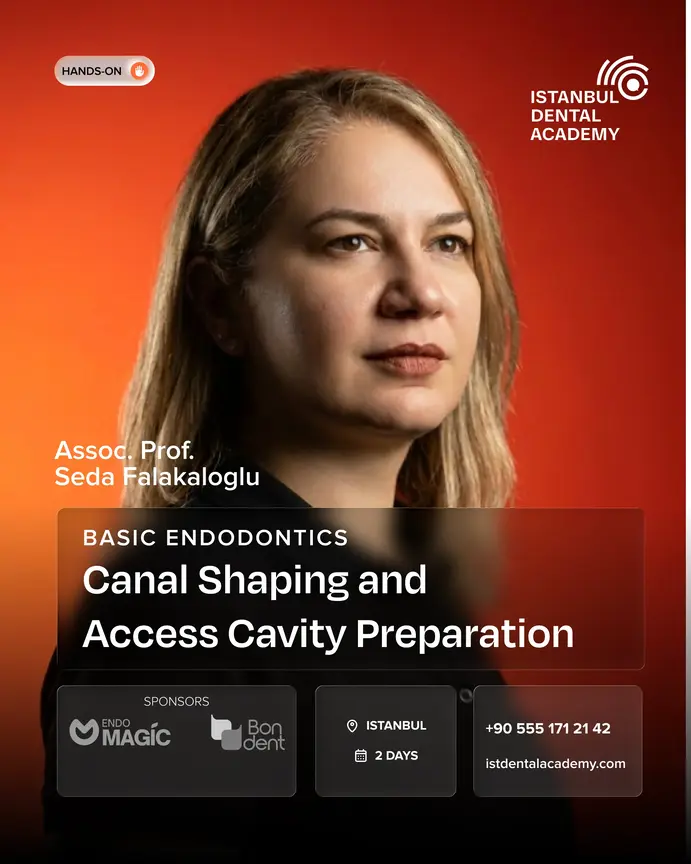
- Starting date : 19 December 2026
- Finishing date : 20 December 2026
- Duration: 2
- Course price: Ask for price.
- Course quota : 16
- Location: İstanbul
- Course language: Turkish
December
Basic Endodontics: Access Cavity Preparation and Canal Shaping
This course is designed for dentists and senior dental students who wish to improve their knowledge and clinical skills in the field of endodontics. It includes a series of theoretical sessions and hands-on practical exercises. The course is conducted with microscope support.
Course Overview
This 2-day intensive hands-on course is designed for dentists and final-year dental students who wish to develop their knowledge and clinical skills in endodontics. Through a microscope-assisted training approach, participants will develop their understanding and practical skills in appropriate case selection, clinical decision-making, assessment of root canal anatomy, and contemporary canal preparation and irrigation protocols.
Theoretical Training
The course will address the clinical decision-making processes that influence the success of endodontic treatment, including restorative and technical difficulty criteria in case selection and prognosis assessment. Following the principle that “anatomy determines the system,” the course will examine access cavity design, working length determination, and the biomechanical principles of irrigation.
The management of anatomical variations, the risk of canal transportation in curved canals, the clinical characteristics of oval canals, and contemporary irrigation activation techniques will also be evaluated in accordance with current clinical approaches.
Hands-on Training
Participants will perform exercises under the operating microscope, including safe glide path creation using hand files and assessment of root canal anatomy. Controlled canal shaping with rotary file systems, taper awareness, apical analysis, and the clinical differences between .04 and .06 taper will be practiced on resin models.
Additional exercises will include curved canal management, minimally invasive preparation, irrigation activation, and oval canal preparation. All procedures will be performed under direct instructor supervision, with individualized feedback provided throughout the practical sessions.
What You Will Learn in This Course
By the end of the course, participants will be able to:
Apply appropriate clinical decision-making and case selection principles in endodontics
Evaluate restorative and technical difficulty criteria and prognosis
Understand the influence of root canal anatomy on access cavity and preparation design
Perform safe glide path creation techniques
Apply principles of working length determination and apical assessment
Perform controlled canal shaping using rotary file systems
Understand the clinical differences between .04 and .06 taper
Apply principles for managing the risk of canal transportation in curved canals
Manage different oval canal anatomies
Apply contemporary irrigation activation techniques
Understand and implement minimally invasive preparation principles
Sponsors


Course flow
-
09.00 - 09.45
Endodontik Tedavide İlk Değerlendirme ve Karar Verme
- Restoratif Potansiyel - “Bu diş restore edilebilir mi?”
- Periodontal ve Destek Durumu - “Bu diş mekanik olarak taşınabilir mi?”
- Endodontik Zorluk Seviyesi - “Teknik olarak öngörülebilir mi?”
- Hasta Faktörü - “Uzun dönem başarı gerçekçi mi?”
-
09.45 - 10.15
Katılımcılar Tarafından 3 Vakanın Sınıflandırılması İyi - Orta - Şüpheli - Umutsuz
-
10.15 - 10.30
Kahve Arası
-
10.30 - 12.00
Kanal Tedavisinde Kanal Şekillendirme Stratejisi
- Giriş Kavitesinde Dikkat Edilmesi Gerekenler
- Apeks bulucu kullanımının püf noktalar
- Anatominin Okunması; “Anatomi eğe sistemini belirler.”
- Kontrollü Genişletme; “Şekillendirme, kontrol sanatıdır.”
- Restoratif Geleceği Koruma; “Bugünkü taper, yarının kırığını belirler.”
-
12.00 - 13.00
Öğle Yemeği
-
13.00 - 15.00
Hands-on: Kılavuz Yol Oluşturma ve Anatomi Değerlendirme - Mikroskop Destekli
- #08 - #10 - #15 ile giriş
- Rekapitülasyon disiplini
- Çalışma boyu kontrolü
- Patensiyi kaybetmeme
-
15.00 - 15.30
Kahve Molası
-
15.30 - 17.00
Hands-on: Kontrollü Döner Eğelerle Şekillendirme
-
17.00 - 18.30
Hands-on: Kanalda Konikliğin Farkındalığı ve Apikalin Değerlendirilmesi
-
09.00 - 10.30
Farklı Kanal Anatomilerinde Karar Verme
Eğri Kanal
- Eğriliği düzleştirme refleksi
- Transportation başlangıç noktası
- Küçük taper – kontrollü ilerleme
Molar Oval Kanal
- Özellikle distal veya palatinal oval yapı
- Yuvarlaklaştırma tuzağı
- Furkasyon tarafında dentin incelmesi
-
10.30 - 11.00
Kahve Molası
-
11.00 - 13.00
Hands-on: Orta Derecede Eğri Kanalarda Kılavuz Yol ve Merkezleme
1. Aşama – Kılavuz Yol
- #08 – #10 – #15 dikkatli ilerleme
- Rekapitülasyon disiplin
- Çalışma boyu kaybetmeme
2. Aşama – Döner Eğelerle Merkezleme
- Basınç azaltma
- Küçük taper seçimi
- Eğriyi düzleştirmeme
- Transportasyonun erken farkındalığı
-
13.00 - 14.00
Öğle Yemeği
-
14.00 - 15.30
Hands-on: İrrigasyon Aktivasyonu
-
15.30 - 16.00
Kahve Molası
-
16.00 - 17.30
Hands-on: Oval Kanal Preparasyonu ve Dentin Koruma
Lecturers