
Courses
- Starting date : 24 October 2026
- Finishing date : 25 October 2026
- Duration: 2
- Course price: Ask for price.
- Course quota : 20
- Location: İstanbul
- Course language: Turkish
October
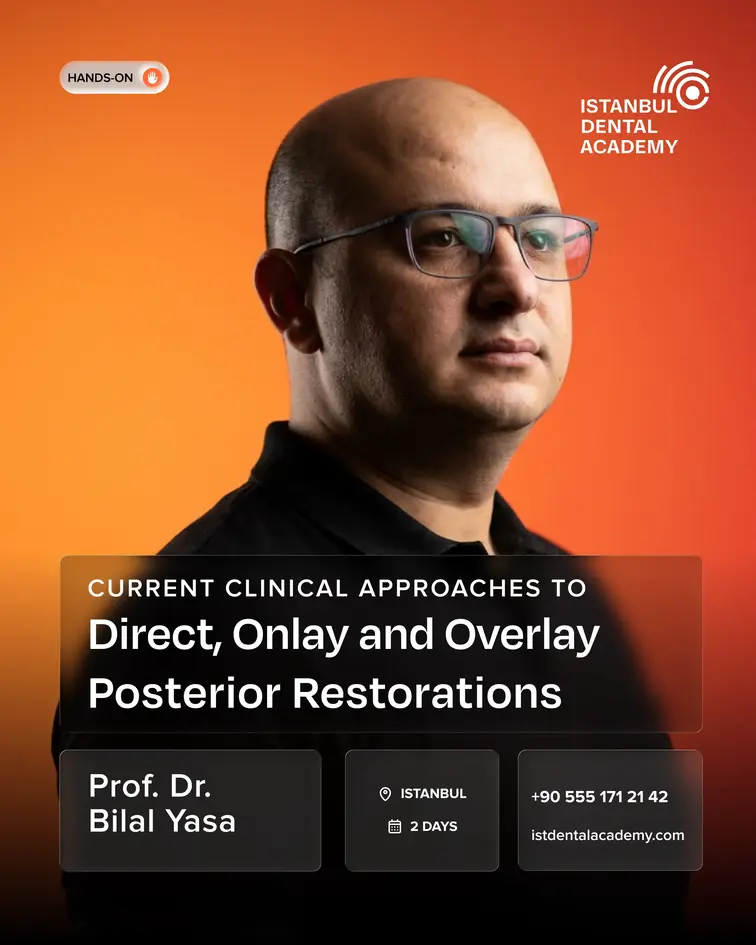
Current Clinical Approaches To Direct, Onlay And Overlay Posterior Restorations From Diagnosis To Treatment
Course Overview
This 2-day hands-on course provides a comprehensive approach to posterior restorative dentistry, covering the treatment process from direct composite restorations to indirect restorations. The course aims to develop participants’ ability to evaluate esthetic, functional, and biomechanical principles, select appropriate materials and techniques, and apply the key clinical steps of posterior restorative procedures in a structured hands-on environment.
Theoretical Training
The course covers esthetic, functional, and biomechanical parameters in posterior composite restorations, as well as the properties and clinical limitations of contemporary composite materials. Isolation, caries removal and cavity preparation, matrix selection and matrixing techniques, adhesive protocols, composite material selection, layering techniques, anatomical morphology, and finishing and polishing procedures will be discussed through clinical cases. Indirect posterior restorations will also be addressed, including the clinical workflow from preparation to finalization, the characteristics of different restorative materials, and the clinical outcomes associated with material selection. The fundamentals of CAD-CAM scanning and design, as well as the clinical application of overlays and endocrowns, will also be discussed.
Hands-on Training
Participants will practice rubber dam isolation in the posterior region on phantom jaw models. Class II composite restorations will be performed step by step, from cavity preparation through layering, anatomical morphology development, finishing, and polishing. During the second part of the course, participants will perform overlay and endocrown preparations on phantom models and take part in a CAD-CAM scanning and design workshop. Cementation and finishing procedures will then be practiced step by step using models and restorations produced with 3D printing technology.
What You Will Learn in This Course
Evaluation of esthetic, functional, and biomechanical parameters in posterior restorations
Properties and clinical limitations of contemporary composite materials
Rubber dam isolation and effective moisture control techniques
Principles of caries removal and cavity preparation
Matrix selection and matrixing techniques
Adhesive protocols for posterior composite restorations
Selection of appropriate composite materials and layering techniques
Development of anatomical morphology in posterior composite restorations
Finishing and polishing procedures
Preparation principles for indirect posterior restorations
Overlay and endocrown preparation techniques
Clinical criteria for restorative material selection
Fundamentals of CAD-CAM scanning and design
Cementation and finishing procedures for indirect restorations
Course flow
-
09.00 - 09.30
Welcome
-
09.30 - 11.00
Direct Composite Restorations – DIAGNOSIS
- Biomechanics of posterior teeth
- Occlusal assessment and functional principles of posterior dentition
- Posterior tooth morphology: Esthetics or function?
- Contact points and contours from biological and functional perspectives
- Should endodontically treated teeth be managed like natural teeth?
- Most common clinical challenges in posterior composite restorations
- Manipulation, postoperative sensitivity, fractures, and marginal adaptation
- Indications for direct composite restorations
- Historical development of composite materials: Past, present, and future
-
11.00 - 11.30
Coffee Break
-
11.30 - 13.00
Direct Composite Restorations – TREATMENT
- Importance of isolation and rubber dam application in posterior restorations
- Caries excavation: How much and how far?
- Cavity preparation: How cavity design and location influence prognosis
- Strategies for pulp protection
- Are liners and bases still necessary?
- Adhesion concepts: What has changed?
- Adhesive selection and clinical tips for long-lasting restorations
- Matrix systems: Selection and techniques for achieving tight proximal contacts
- Composite selection: Which composite should be used and when?
- Fiber reinforcement: Indications and clinical applications
- Reproducing natural morphology
- Layering techniques and clinical tips
- Selection and use of instruments for composite layering
- Finishing and polishing techniques for durable and natural-looking restorations
- Troubleshooting and maintenance of restorations
- Repair protocols and critical considerations
- Interactive discussion of clinical cases
-
13.00 - 14.00
Lunch
-
14.00 - 15.30
Hands-on: Rubber Dam Application on Posterior Teeth Using Phantom Jaw Models
-
15.30 - 16.00
Coffee Break
-
16.00 - 18.00
Hands-on: Class II Composite Restoration with Layering Technique on Phantom Jaw Models
-
09.00 - 09.30
Review of Day 1
-
09.30 - 11.00
Indirect Restorations, Onlays & Overlays – DIAGNOSIS
- When should indirect restorations be preferred?
- What is a semi-direct restoration?
- Contemporary posterior restorations: Inlays, Onlays, Overlays, Tabletops, and Endocrowns
- Trend or evidence-based reality? What does the literature say?
- Cuspal coverage: Why, when, and how much?
- Impact of digital technologies on modern dentistry
- Material selection for indirect restorations
- Glass ceramics, hybrid ceramics, or composites?
- Material options for CAD/CAM restorations
- Can permanent restorations be fabricated using 3D printing?
-
11.00 - 11.30
Coffee Break
-
11.30 - 13.00
Indirect Onlay & Overlay Restorations – TREATMENT
- Tooth preparation principles for indirect restorations
- Retraction and bleeding control
- Adhesive protocols for tooth substrates
- IDS (Immediate Dentin Sealing)
- BioBASE concept
- DME (Deep Margin Elevation) / CMR techniques
- Impression techniques: Conventional or digital workflow?
- Provisionalization options
- Try-in and adjustment procedures
- Adhesive protocols for indirect restorations
- Surface conditioning and silanization
- Cement selection and cementation protocols
- Finishing and polishing procedures according to restorative material
- Interactive discussion of clinical cases
-
13.00 - 14.00
Lunch
-
14.00 - 15.30
Hands-on: Endocrown and Overlay Preparations on Phantom Models
-
15.30 - 16.00
Workshop: CAD/CAM Intraoral Scanning and Restoration Design
-
16.00 - 18.00
Hands-on: Cementation and Finishing Procedures on Prepared Models
-
18.00 - 18.30
Q&A Session - Certificate Ceremony
Lecturers