
Courses
- Starting date : 05 September 2026
- Finishing date : 06 September 2026
- Duration: 2
- Course price: Ask for price.
- Course quota : 23
- Location: İstanbul
- Course language: Turkish
September
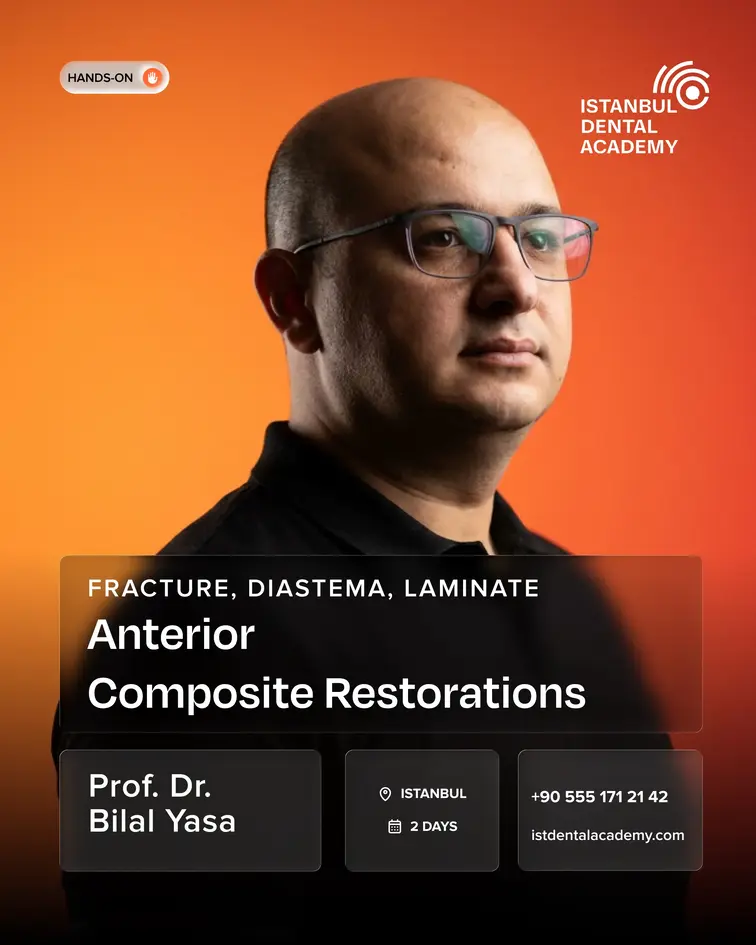
Anterior Composite Restorations: Fracture, Diastema, Laminate
About the Course
This two-day hands-on course focuses on the planning and execution of aesthetic and functional composite restorations in the anterior region, including fractured tooth restorations, diastema closure, and composite veneers. Participants will develop a systematic approach to clinical procedures, from case selection and treatment planning to the finishing and polishing stages of the restoration.
Theoretical Training
The course will cover the evaluation of aesthetic and functional parameters, shade selection, the optical properties of composite materials, adhesive systems, isolation and rubber dam techniques, preparation, matrixing, and various layering techniques. Through clinical case analyses, different composite systems and clinical treatment approaches will be evaluated interactively.
Hands-on Training
Following the theoretical sessions, participants will perform anterior fracture restorations, diastema closures, and composite veneer preparations and restorations on typodont models. Each procedure will be carried out step by step, from preparation through to the finishing and polishing stages.
What You Will Learn in This Course
Esthetic and functional analysis of anterior cases
Proper shade and composite selection
Rubber dam isolation and moisture control techniques
Matrixing and layering techniques
Anterior fracture restorations
Diastema closure
Composite veneer techniques
Finishing and polishing techniques
Kurs Programı
-
09.00 - 09.30
Welcome
-
09.30 - 11.00
Case Analysis
- The importance of esthetic parameters in composite restorations
- Case analysis guided by esthetic principles
- Direct or indirect? Evaluating functional parameters for treatment planning
- Clinical implications of the historical development of composite materials
- Current challenges and limitations of modern composite systems
- Color science and reproducing the natural tooth appearance with composite resins
- Techniques and practical tips for accurate shade selection
- Essential equipment and tips for basic dental photography
- Clinical photography, documentation, and digital case analysis
-
11.00 - 11.30
Coffee Break
-
11.30 - 13.00
Anterior Fracture Restorations
- Morphological and esthetic characteristics of dental tissues
- Preparation principles: Where? How much? How?
- The concept of adhesion to dental tissues and practical clinical tips
- Tips for adhesive selection and application
- The importance of isolation and effective rubber dam application
- Fabrication of a customized matrix
- Simplified matrix techniques for anterior restorations
- Layering technique essentials: Which composite should be used and how?
- Alternative layering techniques
- Selection and proper use of instruments and accessories for composite layering
- Finishing and polishing protocols for long-lasting, natural-looking restorations
- Troubleshooting, evaluation, and clinical tips for predictable outcomes
- Interactive discussion of clinical cases and treatment strategies
-
13.00 - 14.00
Lunch Break
-
14.00 - 15.30
Hands-on: Rubber Dam Application on Posterior Teeth Using Phantom Jaw Models
-
15.30 - 16.00
Coffee Break
-
16.00 - 18.00
Hands-on: Class II Composite Restoration with Layering Technique on Phantom Jaw Models
-
18.00 - 18.30
Q&A Session
-
09.00 - 09.30
Review of Day 1
-
09.30 - 11.00
Indirect Restorations, Onlays & Overlays – DIAGNOSIS
- When should indirect restorations be preferred?
- What is a semi-direct restoration?
- Contemporary posterior restorations: Inlays, Onlays, Overlays, Tabletops, and Endocrowns
- Trend or evidence-based reality? What does the literature say?
- Cuspal coverage: Why, when, and how much?
- Impact of digital technologies on modern dentistry
- Material selection for indirect restorations
- Glass ceramics, hybrid ceramics, or composites?
- Material options for CAD/CAM restorations
- Can permanent restorations be fabricated using 3D printing?
-
11.00 - 11.30
Coffee Break
-
11.30 - 13.00
Indirect Onlay & Overlay Restorations – TREATMENT
- Tooth preparation principles for indirect restorations
- Retraction and bleeding control
- Adhesive protocols for tooth substrates
- IDS (Immediate Dentin Sealing)
- BioBASE concept
- DME (Deep Margin Elevation) / CMR techniques
- Impression techniques: Conventional or digital workflow?
- Provisionalization options
- Try-in and adjustment procedures
- Adhesive protocols for indirect restorations
- Surface conditioning and silanization
- Cement selection and cementation protocols
- Finishing and polishing procedures according to restorative material
- Interactive discussion of clinical cases
-
13.00 - 14.00
Lunch Break
-
14.00 - 15.30
Hands-on: Endocrown and Overlay Preparations on Phantom Models
-
15.30 - 16.00
Workshop: CAD/CAM Intraoral Scanning and Restoration Design
-
16.00 - 18.00
Hands-on: Cementation and Finishing Procedures on Prepared Models
-
18.00 - 18.30
Certificate Ceremony
Lecturers